

The cracks in everything…
By Josine Stremmelaar (Hivos) and Remko Berkhout (Transition Companion for changemakers). Views are the authors' own.
In our previous blog, we congratulated the social innovation movement on its achievements for the past ten years. In this blog, we focus on the future. We offer three shifts for the social innovation movement to enhance its transformative potential.
Focus in times of turbulence?
These are turbulent times. There is no shortage of adrenalin filled apocalyptic prophecies: “Hack the planet!”, “Reboot our systems!”. Trump and Brexit are merely our least favourite bogeymen. Headlines spelling disaster wake us up, but can also distract.
For reality is more complex and progress remains underreported. Look at the global HIV/AIDS response for example. That fight is far from won, but humanity has come a long way in less than four decades, thanks to the collective efforts of ordinary citizens, activists, bureaucrats, pop-stars, philanthropists, tax dollars and doctors. Sometimes, say in the case of women’s rights in the MENA region, holding the line is the best we can hope for. Sometimes it’s nothing but a cop-out. Europe’s migrant crisis comes to mind. Decay, crisis and bad policy sow the seeds of progress. Think of flourishing social innovations like time banks, energy cooperatives and community-based healthcare schemes.
Yes, for the next decade we need more social innovation. Yes, we need to strengthen and grow this movement. But the biggest challenge is to smarten up, to become better at spotting and exploiting the leverage points for change. The question is how, in the words of Michael Edwards, to "move the ‘thinnest'" of innovations in the direction of deeper impact.
A good example is the Finance Innovation Lab. Their ambition is to build a financial system that works for people and planet. The team at the heart of this growing community understood early on that one of its main tasks is to forge connections between radical innovators, reformers and campaigners. They develop working methods connecting societal change, institutional change and personal change. Learning, documentation and generous sharing are seen the best method for scaling. Their documented stories and methods inspire countless other initiatives across sectors.
Momentum towards the masses
Clearly, the world of lived realities offers the most fertile soil for a more transformative social innovation practice. As Alex Ryan argues, social innovation is fast becoming mainstream in policy circles, but has not yet been able to reach the masses.
The pitfall of elitism is around the corner. Ordinary citizens and activists get turned off by 'vogue' concepts such as pop-up markets, innovation labs, fail-fests, and prototypes. ’Hipster talk!’, pensioners told us on a recent visit to the acclaimed Belvedere house of stories in Rotterdam.
If we are serious about putting people at the center, we need to move beyond user profiles, beyond sanitized concepts of change. Inclusive social innovation may require a practice that is slower, more expensive and less sexy. In our Food Change Lab in Fort Portal, Uganda, we try to actively engage informal street vendors. Unorganized, dispersed and controversial, this group is hard to reach, yet they hold fundamental pieces of the puzzle of how a fast growing African city eats. The social innovation in this case is nothing magical other than enabling a seat at the table of the urban planners shaping the future of their city.
From genius to scenius
The broader point here is a shift from from ‘genius’ to ‘scenius. The toolbox of individual innovation processes is filling up nicely. More attention is being paid to the architecture of social innovation eco-systems. But ‘scenius’ goes a few levels deeper and suggests more attention to the fertile grounds of creativity, collaboration and curiousity. The social innovation movement can’t afford to turn its back on issues such as closing civic spaces, the curtailing of freedoms, and the destruction of social infrastructure. There are trade-offs begging reflection. In countries like Kenya, tech hubs can barely absorb donor offers for hackathons and innovation prizes, whilst human rights organizations can’t find the funds to fight impunity and corruption.
Worse perhaps, sometimes we become our own worst enemies. In Berlin, social investors are replacing cheap spaces for creatives with centers for start-ups. Can we let governments get away with refugee quotes and spending cuts for crucial infrastructure such as libraries and youth centers, whilst celebrating the few that find the endurance and creativity to re-invent themselves? Can we follow the example of cities like Hull and Bristol and strike coalitions with movements for alternative currencies and universal basic income as enablers of more transformative innovations?
What if we would treat such linkages as the ‘low hanging fruit’ of a more connected practice? Can we turn the breadth of the social innovation to deepen our understanding of change, how it happens, how it gets coopted and how we can navigate our way forward? As we suggested in our previous blog, social innovation brings together bodies of knowledge on public sector reform, international development, design thinking, software development and a range of other disciplines. This is a great resource to work from. But we need more cross-fertilization, more transdisciplinary research and methods to root such work in everyday lived realities. If this sounds abstract, it is because it is: we need to find different ways of producing knowledge, beyond the academic science, beyond the realm of the rational. Bring on the painters, poets, graffiti artists.
Following after Leonard Cohen: The challenge for the next ten years is not to find a perfect offering. We need to become better at finding the cracks in everything.
That’s how the light gets in.

To act anew is our proud declaration
Reflections on the SIX Wayfinder and summary of Charlie Leadbeater's closing speech by Allyson Hewitt of MaRS Discovery District in Canada. Views are the author's own.
In a world that feels out of control people will want more …
Escapism – from an out of control world they can no longer abhor
A different possibility is what we must offer
A new form of Capitalism on the plate that we proffer
In a world that feels out of control people will want more …
Resistance – to living unacceptable lives that feel like a chore
And we can offer the ability to create the right kind of relationships
All along, as our population shifts
People are waiting to live in truth, while in a system of lies
To fight for and with them, the system they despise
In a world that feels out of control people will want more …
Coping mechanisms – to do better than before
We fall into a cult of resilience and grit
And slogans like “keep calm and carry on” are all that will fit
Our heroes like Merkel are “Copers in Chief”
As we exist in a world of our own disbelief
In a world that feels out of control people will want more …
Conservation - of human potential, we cannot ignore
We can create ideas around which others can organize
Indifference to humanity we cannot normalize
In a world that feels out of control people will want more …
Movements - that literally move people across the floor
With new leaders emerging from Zukerburg to the Pope
Our message of linked beating hearts will help us all cope
In a world that feels out of control people will want more …
Opportunities that are transformative and generative to explore
It is time to change the rules of the game
With new flows of resources which are no longer the same
This is our time because people need ideas that are new
We are all searching for something concrete we can do
So as Lincoln declared we must rise to the occasion
And to act anew is our proud declaration

Let’s celebrate the social innovation movement!
By Josine Stremmelaar (Hivos) and Remko Berkhout (Transition Companion for changemakers). Views are the authors' own.
Last week, the social innovation field celebrated its ten years of existence at the Wayfinder event organized by SIX and hosted NESTA. We join in this celebration as there is much to be proud of.
One major achievement is that we now have a global platform for innovators and early adopters from all segments of society. These include progressive innovators, entrepreneurs, activists, funders and politicians. Like no other changemaker community before, social innovation has shattered many barriers. Instead of ‘fighting existing realities’, it has brought more attention to the craft of crafting alternatives. We’re seeing exciting collaborations that were unthinkable a decade ago – for instance, between artists and planners, between techies and development workers. And we haven’t even begun to exploit the fusion potential of design thinking, participatory development and systems change approaches.
The social innovation field owes much of its appeal to a sense of optimism and its courage to play. Our toughest challenges offer a fertile ground for new solutions. Our globalized world offers an abundance of new possibilities. Social innovators like to frame the current moment as the eye of the storm, a great turning, a shift from ego- to eco-systems. Progress may be slow and erratic, but we are on the right side of history, on the road towards a better life for all.
And yet, this is a good moment to ask: to what extent has the social innovation field been able to change the game? Has it been able to alter the seismic forces underneath contemporary problems? Think of the hegemony of neoliberalism, gender inequality, and the broken relationships between man and nature.
Some argue that it is far too early to tell. What’s a decade in the face of Polyani’s great transformation? Yet the connected chain of developments, from Brexit to Trumpism, from Duterte to Erdogan, from freezing refugees to roll backs on women’s rights, are a wake-up call. The momentum may be turning against progress. The status quo won’t give up without a fight. So even though a brighter future is not inevitable, we need to raise the game. In our next blog, we will recommend to keep our sense of optimism, whilst proposing four shifts to move the field from a state of ‘free play’ to one of ‘inclusive interactions.'
In our next blog, we will recommend to keep our sense of optimism, whilst proposing four shifts to move the field from a state of ‘free play’ to one of ‘inclusive interactions.'

Getting Ready: Recommended Reading
Josine Stremmelaar (NL) Hivos

It's The Penguin Lessons from Tom Mitchell:
I found this book so refreshing because it triggers an enormous curiosity for getting to know the other in a profound way. Just as the Jonathan Livingston Seagull story, it captivates your interest in a bird that behaves in an almost human way (both penguins and seagulls are very social and cooperative creatures). It makes you want to experience penguin interaction in their natural habitat, rather than in a zoo (an unnatural environment). For me, this is something we should continue to do as the social innovation field is maturing. Let's not mainstream curiosity and toolbox our experiences, but keep moving forward with an open mindset, will and heart.

Alice Evans (UK) Lankelly Chase
This is a book I think is amazing and relevant for all the work we’re doing. It’s John Gottman 7 Principles For a Healthy Relationship. I can give a description of why as well, otherwise people might think my relationship is in challenge.
My brilliant, non-work related recommendation is Viv Albertine's Clothes, Clothes, Clothes. Music, Music, Music. Boys, Boys, Boys
Also The Women’s Room has completely blown me away but, again, that’s not work related. But powerful and sadly still relevant feminist fiction from the 1970s – if you haven’t read it then please do.
Ibon Zugasti (EUK) Mondragon
My recommendation would be Shaping the Future - Thoughts on the Future of Society and Governance, a publication coordinated by the European Strategy and Policy Analysis System (ESPAS), in which I recently wrote a small chapter with other authors, such as Geoff Mulgan. The publication is a collection of short essays from a range of experts that focus on the future of society and governance, and what some of the global, long-term trends facing the European Union are.
Jessica Seddon (IN) Okapi
My book recommendation is Silk Roads, by Peter Frankopan - it's a history of the area between the Mediterranean and China. It’s somewhat of an overview of the rise and fall of various empires, movements and markets in this area. It's interesting because it's about the interaction between all kinds of social organisation - no structures are taken for granted. It's a very clear reminder of how unusual our current arrangement of nation-states and still-visible cultural dominance of the west in many arenas is. Also just a good book.
The platform I would like to recommend is https://nextjournal.com/. Along with the rise of citizen science (often empowered by new, lower-cost, easier-to-use data collection), this is a peek at a pretty significant shift in the production structure of "official, certified" knowledge. It allows the guts of research to be exposed for crowd peer review, extension, and addition. It's just starting, and very tech-y, but I believe it could be a new kind of basis for emergent social learning.
Also: Pue, Vandergeest, and Breznitz' Toward a Theory of Social Innovation (2016). I think the definition is particularly useful for framing both strategic approaches to action and attempting to pull together larger meta-analysis for learning about how to "do" social innovation. I also like the fact that it acknowledges the risk that attempts to do good will fall short or even do harm.
Ndidi Okonkwo Nwuneli (NG) LEAP

The two things that I would like to share, which I realise may appear a little like self promotion, but I think really capture some breakthrough insights that I gained from interviewing over 80 social innovators working across Africa.
My new book, which broadly focuses on filling the knowledge gap for those tackling Africa’s serious social problems: Social Innovation In Africa - A practical guide for scaling impact
Also an article that I wrote a few years ago, that examines the importance of supporting local innovators to achieve new systems thinking and change: Creating a Level Playing Field for Social Innovators in Africa
Martin Stewart-Weeks (AU) PwC
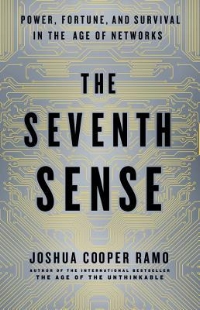
I have a number of book recommendations, that broadly focus on the themes of systems change, the future of governance, networks and leadership. They are listed below:
- Beth Simone Noveck, Smart Citizens, Smarter State: The Technologies of Expertise and the Future of Governing
- Joshua Cooper Ramo, The Seventh Sense, Power: Fortune and Survival in the Age of Networks
- Christian Bason, Leading Public Design: Discovering Human Centred Governance
- David Peter Stroh, Systems Thinking for Social Change: A practical guide to solving complex problems, avoiding unintended consequences and achieving lasting results
- Nicholas Timmins (The Kings Fund), The practice of system leadership: Being comfortable with chaos
Kriss Deigelemeir (US) Tides
My first book recommendation is The Inevitable by Kevin Kelly. Written by one of the leading technology thinkers and writers, this book forecasts and outlines twelve technological forces that will shape the next 30 years.
My other choice is Quantified: Redefining Conservation for the Next Economy by Joe S. Whitworth. In Quantified, Whitworth draws lessons from the world’s most tech-savvy, high-impact organizations to show how we can make real gains for the environment. He argues that environmental conservation can learn key lessons on innovation, efficiency and success from the likes of Apple, Uber and Google.
From Stephen Huddart (CA) The J.W. McConnell Family Foundation
My recent Walrus talk entitled Social Innovation in the Era of Reconciliation: An open letter to Justin Trudeau
Video: https://www.youtube.com/watch?v=fIMD2at-v1E
Written transcript: https://thewalrus.ca/social-innovation-in-the-era-of-reconciliation/
From Nishant Lalwani (UK) Global Innovation Fund
In Science Magazine, "The long-run poverty and gender impacts of mobile money," by Tavneet Suri and William Jack
From Joeri van den Steenhoven (CA) MaRS Solutions Lab
In Journal of Design Strategies, "A Periodic Table for Systems Change," by Joeri van den Steenhoven
Cathy Glover (CA) Suncor energy Foundation
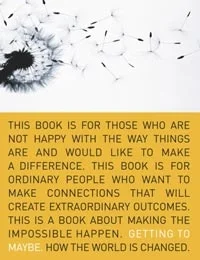
I’m a big fan of Getting to Maybe: How the World is Changed by Frances Westley, Brenda Zimmerman and Michael Quinn Patton and Blindspot – Hidden Biases of Good People by Mahzarin R. Banaji and Anthony G. Greenwald.

Edwin Huizing (NL) Hivos
For work I have been reading "Uganda Food Change Lab: Planning for the future food system of Kabarole district" by Hivos, the International Institute for Environment and Development (IIED) and Kabarole Research and Resource Centre (KRC).
However, more fun, personally I am reading Born to Run by Bruce Springsteen.
FROM SAM BAKER (UK) MONITOR DELOITTE
"2016 Mobile Industry Impact Report: Sustainable Development Goals" by GSMA and Deloitte
"2030 Purpose: Good business and a better future" by Deloitte