

Social innovation – the last and next decade
Geoff Mulgan of Nesta gives an overview of what was achieved over the last decade in the field of social innovation, what’s missing, and what might be 10 priorities for the decade ahead, in what is likely to be a much less favourable political climate in many countries.
Social innovation is not a new concept or practice, but in the last decade it has taken off. There are now hundreds of social innovation centres, funds, courses and incubators of all kinds, most of which didn’t exist 10 years ago.
In this short, and far from comprehensive, note - prepared for the SIX Wayfinder, which Nesta is hosting this month - I attempt an overview of what was achieved over the last decade, what’s missing, and what might be priorities for the decade ahead, in what is likely to be a much less favourable political climate in many countries.
2007-2017: What happened?
Ten years ago (in 2006), an event was held in Beijing which led to the creation of SIX, the Social Innovation Exchange. The event brought together foundations, innovators, social entrepreneurs, and corporates, along with senior figures from governments in China, the UK and elsewhere. It set out a rough roadmap towards making social innovation more mainstream (and led to the report ‘Social Silicon Valleys’) at a time when many were trying to build on what had been achieved in supporting social entrepreneurship and social enterprise and were attempting to move to a more systematic approach to social change.
Much of what that report advocated in 2006 has materialised. It recommended:
- New sources of finance focused specifically on innovation, including public and philanthropic investment in high risk R&D, targeted at the areas of greatest need and greatest potential;
- ore open markets for social solutions, including public funding and services directed more to outcomes and opened up to social enterprises and user groups as well as private business;
- New kinds of incubator for promising models, and ‘accelerators’ to advance innovation in particular areas such as, for example, chronic disease or the cultivation of non-cognitive skills;
- New ways of empowering users to drive innovation themselves – with tools, incentives, recognition and access to funding for ideas that work;
- New institutions to help orchestrate more systemic change in fields like climate change or welfare – linking small scale social enterprises and projects to big institutions, laws and regulations;
- New institutions focused on adapting new technologies for their social potential – such as artificial intelligence - … as well as more extensive, rigorous, imaginative and historically aware research on how social innovation happens and how it can be helped.
The implementation of these ideas has often been messy and fragmented. But the movement has come a long way forward.
National cultures remain very diverse – and what social innovation means in Bangladesh (home of some of the strongest institutions for social innovation like BRAC and Grameen) or Kenya (home of Ushahidi and some of the most dynamic digital innovation) is very different from what it means in a US city, or a European nation. But there are some common patterns.
One is the spread of social innovation centres and labs – physical spaces and organisations aiming to promote social innovation in the round, with prominent examples in: Quebec, Adelaide, Amsterdam, Beijing, Delhi, Lisbon, Rio, Tillberg and the Basque Country and many others.
Some are based on foundations (like the Lien Centre in Singapore or Bertha in Cape Town), others on buildings (such as the CSI in Toronto).
There’s been a big expansion of social investment funds - although only a small minority focus on innovation, these provide a new route to help innovations grow to scale - and of new funding tools that can support social innovation, such as crowdfunding platforms
Many governments have created social innovation funds (from Hong Kong and Australia to France and the US) and fairly comprehensive national policy programmes have been introduced in a few countries, from Malaysia to Canada.
The European Commission has also incorporated social innovation into many of its programmes, including the European Social Fund and the Horizon 2020 science and research funding.
The UAE now commits 1 per cent of public spending to public innovation – a rare example of shifting towards more serious allocations.
There are dozens of university research centres (from Dortmund, Waterloo, Stanford, and Northampton, to Glasgow Caledonian, Vienna and Barcelona) and courses for undergraduates and mature students.
International NGOs – such as Oxfam, Mercy Corps and the Red Cross - are taking innovation much more seriously as a way of responding to new technological opportunities and challenges, as are many UN agencies, notably UNICEF and UNDP.
Many big firms have announced initiatives using the social innovation label, including tech firms like Hitachi and Dell and consultancies like McKinsey and KPMG, even if many are little more than cosmetic.
Social innovation skills are becoming much more widely accessible – for example, through the DIY Toolkit used by nearly one million people worldwide, and through content provided by organisations like IDEO.
Digital social innovation has taken off – around 1,200 organisations were recently mapped by DSI Europe, and there are thousands of others around the world sometimes described with the ‘civic tech’ label
There are hundreds of social innovation incubators and accelerators of all kinds, and transnational networks of social incubators such as GSEN, Impact Hub and SenseCube.
Quite a few Mayors are now defined by their commitment to social innovation (such as Won Soon Park in Seoul or Virginio Merola in Bologna). There are social innovation prizes in the US, Europe, China and elsewhere, new tools such as Social Impact bonds (over 80 in the UK, US, Australia), and new legal forms – like Community Interest Companies and B-Corps.
There are new campaigning tools – like Avaaz and Change.org - and new kinds of social movement pioneering social innovation in fields like disability, refugee rights and the environment.There are social innovation media – such as the Stanford Social Innovation Review (which has partly shifted away from focus on US non-profits to a more international and cross-sector perspective), Apolitical or the Good Magazine. And there have been some significant surveys of the global social innovation landscape, including from the Economist Intelligence Unit, and regional surveys in Latin America, east Asia and Europe.
Finally, there has been at least some progress in clarifying boundaries and definitions. It’s better understood that social innovation is not the same as social entrepreneurship, or enterprise, or creativity, or investment, though these all overlap. My own preference for definitions remains the simple one – innovations that are social in their ends and their means – but there are also plenty of alternatives.
False starts?
Not everything has worked over the last decade. Obama’s Office for Social Innovation in the White House did a lot of good work but will not survive the change of President. The UK’s Big Society programme likewise didn’t survive a change of political leadership.
There have also been some uneasy transitions. Traditional innovation agencies have adopted some of the language of social innovation but with uneven results (although Sweden’s Vinnova, Finland’s Sitra, Canada’s MaRS and Malaysia’s AIM have all done well in complementing technology support with a new focus on social innovation, most have not).
Organisations associated with the earlier wave of programmes devoted to social entrepreneurship have sometimes struggled to achieve a better balance between support for individuals and the broader needs of innovation (given that the model of a single individual developing an innovation, or venture, and then growing it, remains very rare).
The field of social innovation also has its share risks, some of which come from overreaching. One is the risk of fetishising innovation as an end in itself rather than a means to other ends. For most organisations for much of the time, innovation may be much less important than effective implementation of existing ideas or adoption of ideas from elsewhere (I used to advocate that governments should spend around 1per cent on their own innovation, but that the majority of time, money and effort should go into good implementation).
Innovation can often seem exciting and sexy, while implementation and adoption are dull. But innovation without a wider system for implementation and adoption risks being pointless, and funders would often do better to prioritise adoption and adaptation of ideas rather than novelty
A very different risk can be seen in the new tools for advocacy. Anger and expression are vital fuels for social change, but they can become addictive, especially when amplified by social media; with expression becoming an alternative to the hard graft of achieving change.
In general social innovation has steered clear of these traps and successfully made the transition from being a marginal idea to one that is much more mainstream, and healthily focused on practice. This diagram attempts a very rough and incomplete picture of the current landscape, considered through the four main poles of money, power, knowledge and movements.

Yet the scale of activity is still small relative to the scale of needs. The projects and initiatives listed above are modest and most of the organisations mentioned above are fragile. In some fields, hype has greatly exceeded reality so far (including, at times, impact investment). Meanwhile, vastly more innovation funding still goes to the military than to society, and the world’s brainpower is still directed far more to the needs of the wealthy and warfare than it is to social priorities.
More worrying is the shift in climate. Relatively centrist, pragmatic governments of both left and right were sympathetic to some of the arguments for social innovation. By contrast, authoritarian leaders of the kind who are thriving now tend to be hostile, suspicious of civil society and activism of any kind, and much more favourable to innovation that’s linked either to the military or big business.
So what could be achieved over the next ten years during what may be a less favourable climate? What could organisations with power and influence do to strengthen the most useful forces for change?
Social innovation: 10 possible priorities for the next 10 years
Here I suggest ten challenges and priorities that could define whether social innovation becomes a recognised part of the mainstream, or remains more marginal.
1. Tackle big challenges and at the right level of granularity
The most important challenge is to achieve and demonstrate, big inroads on the major issues of our times such as ageing, unemployment, stagnant democracy or climate change. This will require moving on from the units of analysis and action of previous eras. Much past activity focused on the individual (social entrepreneurs and innovators); the individual venture, or the individual innovation. While at the other end of the spectrum, macro initiatives have been trying to change the behaviour of all businesses, or all charities;holding rather abstract discussions of systems change at a global level.
A hunch is that the most impact will come from tackling issues at a middle level – specific sectors in specific places. So, addressing the most complex challenges may be much more practical at the level of systems, or industries in particular places. For example, how to sharply improve the performance of the housing sector, or childcare, or training in a city or region. Here collaborations between foundations, municipal government and others have the potential to achieve significant and lasting impact, but require new vehicles and methods, and a willingness to learn from what has and hasn’t worked over the last few decades.
2. Grow funding at serious scale
A significant proportion of R&D spend, both public and private, needs to be directed to innovations that are social in both their ends and their means. That funding needs to grow steadily in order to ensure there is capacity to use money well. It also needs to be plural, including: grant funds, investment through loans and equity, convertible funding, matched crowd funding as well as public procurement, outcomes based funding and bonds, as well as participatory budgeting.
We need deliberate experiment with new ways of using money - including ways of combining public, philanthropic and private money - and faster learning to find out what works at different stages of the innovation journey (much confusion has come from failing to distinguish the funding needs of early stage, high risk ideas, as opposed to scaling of proven ideas).
3. Link action to evidence of impact
Every aspect of social innovation needs to be attuned to evidence and a willingness to find out what achieves most impact. This doesn’t mean making a fetish of randomised control trials or costly evaluations. But it does require doing much more to embed analysis into the everyday work of organisations; where possible to test alternative models; adoption of common standards of evidence; and promoting a sophisticated understanding of how to discover what works, where, and when.
4. Connect into movements, activism and democracy
Social innovation in many countries will need to become more, not less, political, and willing to campaign on many fronts. That means going far beyond ‘clicktivism’, including direct action in countries where the political climate is hostile to social and civic action. It means linking individual social innovations to broader programmes for change, while also tapping into the emotions that so often drive social change. Politics, and being active in democracy, is vital for social innovations to thrive.
5. Make the most of digital
There’s been an extraordinary flowering of digital social innovation and civic tech, particularly around open data, open knowledge, the maker movement and citizen science. But these haven’t yet made strong links to previous generations of civil society organisations and charities, and many have struggled to achieve large scale.
We need to take civic tech and digital social innovation to the next stage, with the right kinds of finance, incubation and links into procurement.
Projects like CAST in the UK, the Data Academy in Seoul and Civic Hall in New York are useful pointers. Civil society also needs to be active in making the most of maturing technologies – for example, the role of blockchain in creating new currencies, or applying machine learning to social challenges.
6. Shape the next generation Internet
The biggest challenge will be to design the next generation Internet on principles closer to those of social innovation, and indeed to the founding spirit of the Internet and World Wide Web, with open source, open data, net neutrality and citizen control. There are some promising projects underway - such Tim Berners Lee’s SOLID and Ind.ie, and Nesta’s new project on data commons across Europe.
But this will be a major struggle requiring a lot of fresh thinking over the next few years.
7. Broader and deeper social innovation skills
Social innovation depends on certain capabilities: knowledge about how to generate ideas, develop them and scale them. Those skills are scarce and sometimes as much undermined as helped by fashions. We need much more widespread support for practical skills in design, prototyping, pilots, experiments, social investment, evaluation and iteration. These need to include online tools and MOOCs, mobilising existing universities and colleges and creating more grassroots academies.
All serious innovation requires courage and leadership. That leadership can be concentrated right at the top – but the spirit of social innovation is to spread leadership throughout society at every level. That requires action to achieve strength in depth, and capacities to organise, create and manage, supported by philanthropy, public authorities, university networks online providers and peer to peer to support.
8. Better adoption
It’s often assumed that social innovation is all about radical new ideas, and out of the box thinking. But most innovation in most fields is much more about adoption and incremental adaptation. The first question for any innovator should be – what can I borrow or adapt? And funders should give more weight to smart adoption rather than originality. The many ‘what works’ centres can help with this – but there are practical skills involved in adopting and adapting innovations to work in contexts different from the ones they emerged in.
9. Mature policy debate
We’re just beginning to see serious national policies around social innovation. To help these evolve, we’ll need better comparative analysis of multiple national strategies- and ideally competition - as well as reflection on how the goals of innovation policy and social innovation policy might be better aligned, so that policies around funding, new legal forms, tax incentives, procurement and commissioning are better aligned.
10. Continuously reaching out
The risk of any field, such as social innovation, is that it becomes inward looking or an echo chamber. Many in the field are urban, well-educated and young. But the most useful innovation comes from diversity; encounters of people from different backgrounds. So the very tendencies that give the field some of its coherence can also become a trap. This becomes particularly obvious where social innovation is engaging with seriously divided societies. The ability to empathise, to understand symbols, and to heal scars turns out in some contexts to be far more important than overly economistic rationalistic analysis and action.
Achieving these 10 priorities doesn’t require a top down plan, even if one was possible. But they do require rapid global awareness, fast learning, and willingness to cut through hype.
The premise of many of the discussions a decade ago was that too much of the convening around social entrepreneurship and innovation was celebratory and promotional. Not enough was informed by action, and the tough lessons of practice.
That led to initiatives like SIX, which aimed to be guided by practitioners, and were oriented to learning as well as celebration, These initiatives were more global in spirit, recognising that no part of the world was leading. It continues to be true that practice is ahead of theory. As we face a potentially more hostile climate there’ll be even more need for alliances between practitioners and interpreters who can help to take the kernels of new ideas and show their broader transformative potential.
16 February 2017 - SIX Wayfinder is a two-day global social innovation event exploring what more can be achieved in the field over the next 10 years.
From here to there: social innovation from 2006-2027
The following is a visual culmination of the voices, ideas, insights and experiences contributed before, during and after the SIX Wayfinder, documenting the journey of social innovation in the past 10 years and our road ahead for the next 10.
From here to there: social innovation from 2006-2027
The following is a visual culmination of the voices, ideas, insights and experiences contributed before, during and after the SIX Wayfinder, documenting the journey of social innovation in the past 10 years and our road ahead for the next 10.
2006 - current state of field

LONDON 2017: SIX WAYFINDER

our practice for the next 10 years

2027

what can social innovation offer to the world

what can you do next?

Full Infographic
BAck to top

A global response to the most important questions facing the field of social innovation
Jordan Junge of SIX highlights some of the key questions for the future that came out of the 2017 Wayfinder.
In February 2017, SIX hosted our first global Wayfinder event in London. We brought together more than 160 leaders from 34 countries to explore the future of social innovation and our roles within it. There were some clear messages about the very core of what we do, why we do it, and why it matters.
Some of those in the room had first penned the term social innovation; others had started and mobilised movements such as design for social innovation; others had unlocked key funding and resources to help this movement grow around the world; and many had pioneered innovations that are staple case studies in the field. All thought seriously about the current state of social innovation and the world, and their role in creating the future.
We've spent the past few weeks analysing, exploring, thinking, pausing and digging deeper into what came out of the Wayfinder. It was no easy task.
You can see a longer summary highlighting our learning and insights here and a visual culmination that captures the energy of the past and the event and shares ideas for action going forward.
The following are questions that are key to ponder when considering our future:
- How do we grow locally whilst still staying globally? Digital social innovation (DSI) may provide one solution. As Francesca Bria, Chief Technology Officer of Barcelona City Council said 'digital is ultimately about the local, it's about the things that people care about most: food, health, care, etc.' She predicts that the next 10 years of DSI will mean that every city has maker districts for the circular economy & produce energy and food locally, moving towards productive and sovereign cities'.
- How do we activate the radical middle? How do we break through our silos and bubbles to work differently? How do we use innovation to empower people within institutions to discover and unleash their social intrapreneur? Or as Alex Ryan of the Alberta CoLab said 'how do we move beyond the water cooler and get this into the water supply?' How do we ensure that social innovation isn't limited to the 'innovation lab or officer' in the corner? Should we all adopt Millie Begovic of UNDP's time-based approach, in which the lab will shut down in 3 years - because it should have fulfilled its mandate by then or else it should be abolished.
- How do we make our institutions more human, inclusive, responsible and responsive? The conversation kept coming back to the notion of citizenship and a global feeling of isolation and disenfranchised. If we want to live in a world where greater participation and equality is the norm, how do we get there? How can technology help to further democratise our institutions? How do we prepare our next leaders to be more responsive?
- Inspired by the B Corps movement, how do we expand our definition of stakeholder and look beyond the shareholder? As Harvey Koh of FSG India said, 'I'd like to live in a world where business isn't just serving the expectations of shareholders but are truly accountable to society in an equitable way'.
- Collaboration remains essential for the future. The real question is how we train and empower tomorrow's leaders to be comfortable moving and working across the public, private and third sectors? As Mark Moore of the Harvard Kennedy School said all social issues are touched and managed in some way by some combination of the private, public and third sector, and as such, our solutions need to incorporate and be managed by all three.
- How do we focus our efforts on the demand side? If there are social needs and rights that the market won’t reach, but we’ve still decided that they’re important to preserve social standing, then how do we do this? As Mark Moore said 'we’ve been focusing all of our efforts on the supply side, instead of the demand side, which is a mistake. Who are we counting on to want the social change and who will pay for it?'
- How does social innovation create a political strategy? If we want to be successful, we need to have a political strategy. Without a strategy to influence government, social entrepreneurs and innovation will not reach large-scale sustained change. How do we do this effectively and without jeopardising our mission?
- How do we foster a real movement for real people? The past decade has seen the field of social innovation develop out of a multitude of sectors including social entrepreneurship, design and civil society. With this, a new language has been created. However, as innovation author Charlie Leadbeater commentedduring the Wayfinder, the ‘paraphernalia language’ of post-it notes, labs and rapid prototyping risks obscuring the language of what really matters – that of heart, soul and spirit. How do we get back to the heart of what really matters? And how do we share this? As Charlie also said 'if we're going to be a movement, then we need to move people'
- Should we be united in our process or our mission? Should we be united globally in the process of innovation, the practical craft? Or is it enough to be united in the broad mission of improving society for all and it doesn't matter how we get there? Or does it matter? As Tonya Surman of the Centre for Social Innovation in Canada said 'do you need to know you're in social innovation to benefit from it?'
To see more questions and challenges facing the next 10 years, see this short videofeaturing innovation leaders from around the world.
What's next?
We are by no means done... A journey starts with a single step, and the 2017 Wayfinder event set us off down our track.
We want to ensure that this is a global conversation, and we are speaking to organisations across the world to ensure that this vision of the future is collectively shared and understand how we're going to achieve these visions.
Get in touch if you would like to work with SIX to host your own version of the Wayfinder in your country or region. Contact jordan@socialinnovationexchange.org

Insights from the SIX Wayfinder 2017
This short report summarises the discussions, insights and opportunities that surfaced at the Wayfinder
This short report summarises the discussions, insights and opportunities that surfaced at the Wayfinder.

Off the sidelines and into the game
Chris Sigaloff, formerly of Kennisland, reflects on the past ten years of social innovation and where the field should go next - opposing right-wing political movements.
Reflecting on the social innovation field: Chris Sigaloff of Kennisland. Views are author's own.
It was about eight years ago that I came in contact with the social innovation movement. I believe it was at the second SIX conference in Lisbon when I was reading the BEPA report in 2010 ‘Empowering people, driving change: Social Innovation in the European Union’ (written by Agnès Hubert). For me, the concept of social innovation was appealing for differing reasons and gave a very helpful umbrella for the work we were doing at Kennisland, an independent think tank for societal renewal based in Amsterdam.
First of all, it shifted the attention from the economy to real life societal challenges. Until then, the focus was on economic growth as the main driver for societal renewal. Secondly, it made it possible to include non-experts and for normal people to have a part in creating a better society. It democratised knowledge, policymaking and innovation. Social innovation not only focused on politicians, academics and senior executives, but also on normal people... workers, teachers, the elderly, students, and migrants, who were not only seen as consumers, but as real citizens. Thirdly, it gave more attention to processes and ways of working (for methods and approaches, such as design thinking, prototyping etc ), rather than just focusing on good ideas, outcomes and end results; thus, it provided space for learning and experimentation. It made it possible to ask questions, instead of just promoting answers.
The fact that there was a lot of unclarity (different definitions) about the term ‘social innovation’ was – although tiring as hell – quite nice. It made it possible to keep it open, ambiguous and a bit vague. As such it could include more than one meaning and multiple meanings at the same time.
We did many projects in different fields, such as education, the social sector, the cultural sector and, of course, across the different sectors. This was never easy since we were always working from the outside in: fighting the system, trying to get our foot in the door, often being perceived as an add-on or just a nice little creative project or worse: ‘an innovation project’ (which usually meant the end of it).
SIX was a much needed support, a safe haven, the place where you were with likeminded actors, where you could share experiences and gain knowledge, which perhaps explains the overly inward looking character of the social innovation movement.
In the Netherlands, in a few weeks time, we have our national elections. And in times of Brexit and Trump, there really is a very big chance that the populist party will win. They are leading in the polls. It’s very scary. There is so much talk about fear, hate, closing borders. The slogan is ‘Make Holland Ours Again’.
So now the question on my mind is: what can social innovation do to oppose this rightwing movement? What can we do to prevent our country becoming one the most closed countries, instead of the open and liberal country we were once famous for?
Action and positivism
Social innovation actually has the elements that could provide this necessary alternative. Its values are about openness, about inclusion, about empowerment and equality. And its positivism based on hope, instead of on negativism and fear. And on action: doing things, instead of just talking and analysing.
In the Dutch political debate, it seems that social innovation has no real role. I have also remained far from active politics since I do not feel much affiliation with any of the parties. But now I ask myself, have we been so busy setting up experiments, talking about methods and innovating (amongst ourselves) that we distanced ourselves from politics and from the real issues? Have we blinded ourselves by a fake fantasy of ‘making the world better’? Are we losing sight of reality? Are we distracting ourselves from really influencing politics and should we spend more time making the left progressive parties a better alternative? Or even create our own alternative political parties as for example Uffe Elbæk has done in Denmark by setting up the Alternative Party? Or is our work inherently political as it is, since everything we do (empowering teachers, lobbying for open rights etc) is a political act in itself?
So my main question for all of us in the social innovation field is: how can we create an alternative voice, attack some of the current myths (like ‘social entrepreneurship will change the world’ and ‘technology will save us all'), bring back faith to our democratic system and create new appealing visions of the future: where people are not treated as consumers, but empowered citizens, as was stated in the BEPA report.

6 things social innovation can offer to an out of control world
Author Charlie Leadbeater summed up the SIX Wayfinder with six things that social innovation can offer to the future:
Author Charlie Leadbeater summed up the SIX Wayfinder with six things that social innovation can offer to the future:
I want to say a few things of what might be coming and how to interact with it.
Over the past two days at the Wayfinder, we've had a lot of conversations on the good work that we do and the challenges and opportunities ahead, but I do think that if we're all doing such amazing work, we do have to ask ourselves why does everything feels so shit?
That is the question.
I want you to imagine in your mind that we're going to a town that has faced a kind of existential crisis, and the existential crisis has wiped out the material basis for the culture of the town. The people of the town have gathered in the square and they're being made various offers for the future and what we have to do is go into the square, along with a bunch of other people and make an offer to them.
The question is what is our offer? Are we offering systems change, service design, rapid prototyping, a lab? Is that what we're offering?
Because there are a bunch of other people in that square who are offering control. What they’re saying is the world is a complex and uncertain place and I am going to get it under control for you because if it feels out of control. So you see the rise of authoritarian populism, the sort of gutting of democracy, the democratic recession that we're living through which will not come to a halt if Trump is deposed.
Yetunde Aina from Nigeria said if you think that democracy is the best way to run a country you should come to Nigeria. When I asked, well, do you think that sort of efficient authoritarianism is better she said, quite possibly. Tarik Yousef said that visiting Shanghai was interesting, because here was a kind of state that was getting things done in a way that challenged his ideas.
Alongside those people offering control through politics there's a bunch of other people offering control through technology. That's basically Facebook, Amazon, Apple, etc. They're telling people to just wake up, look at me – a phone, a screen, a tablet - and I will tell you what to do.
Just follow what Siri or Alexa tells you to do and it will tell you where to go and what to eat, what to buy, who to mate with, where to go on holiday. Just follow me the technology says.
And actually in the situation that we’re in, if people don't trust politicians, why not trust an engineer because they seem to know what they’re doing? Because they deliver all this stuff to us, that's cheaper and faster and quicker and actually if we just allow them to control our lives it might be a lot better.
What about a world where we all got an Apple basic income? Imagine a future where Apple pay us just enough to keep Apple going, and we get a sort of Apple basic income, as long as we buy everything through Apple.
So if the problem is that the world is out of control, and that’s what it feels like, lots of people are going to offer control as a solution.
If we think, which I think we do, that authoritarian solutions repress human potential, that they're bad for democracy, for equality, for dignity and all sorts of other things; then this is the enemy, both the cause of the authoritarianism and the authoritarianism itself which is our enemy. Tough on authoritarianism, tough on the causes of authoritarianism, so to speak.
What do we, the social innovators and entrepreneurs, have to offer?
Here are six quick things that I’m absolutely sure we’re going to see more of. What is our offer in relation to these tendencies?
1. Escapism
We are going to see a lot more escapism. If you face an existential crisis you want to escape from it. There will be more offers of escape, of distraction, of relief, of respite, or fantasy, fantasy fiction, of immersing yourself in a world of Sky sports for instance, or in the world of drugs. Chris Sigaloff, in her opening talked about social innovation as a fake fantasy. A fake fantasy world that is sort of like a holiday camp.
Escapism, I think, comes in good and bad forms.
I think what we have to offer is a good, utopian escapism. We have to offer a good escapism, we have to go into the square and say to people, come with us, and we will get you out of this mess. We are your escape party. That escape party is about imagining a different possibility, a different future in a world where capitalism cannot re-imagine itself. That's what's happening. The capitalists cannot re-imagine capitalism. So it's going to have to come from somewhere else. And it will come, hopefully, from us. So I think we need to defend escapism of a good kind.
2. Resistance
The second thing we’re going to see a lot more of is resistance and not just resistance to Trump, not just people with banners, not just marches, important though all of that will be, but resistance to living unacceptable lives. I think we'll see more acts of resistance aimed at what Mark Moore calls creating the right kind of relationships because you feel as if you’re not being treated with the kind of dignity and respect that you demand. One of the really good things about the world is the universalisation of the aspirations for dignity and respect. This is a really powerful idea.
I was very taken with Jon Huggett’s story about living in a post-truth world as a gay man and living in truth. What Jon was saying was that he can now live in truth: he can say he loves his partner. Living in truth, this is Václav Havel’s phrase form The Power of the Powerless in 1978 where Havel says, an act of resistance is to live in truth when you live in a system of lies. That is modern America where a president systematically lies. To live in truth is an act of resistance.
I think there’s plenty of offers we can make to people to say we can help you resist, we will help you fight and help you live in truth.
3. Coping
The third thing is there's going to be a lot more coping, because what people do in a crisis is that if control is illusory, escapism is a tendency to fantasy, and resistance is exhausting they you end up coping. Angela Merkel is basically the world’s Coper in Chief. There’s no ideology, there's no vision, let's just cope, let’s keep this all going. Keep calm and carry on. Why do we have such a public cult of resilience and grit: because we are consciously creating our own coping capabilities.
So another offer we should make is this: If you’re coping, we'll help you cope better. When Amalia Zepou talks about what’s happening in Athens basically she’s saying people are coping, but what we’re going to do is help them cope better and build on those capabilities.
4. Creative conservatives
The fourth thing is that we should learn to think of ourselves as creative conservatives. I know that this is controversial because conservatism stands for hierarchy and tradition and its deeply regressive. But it is also very powerful and there may even be a truth to conservatism, or some kinds of conservatism that we need to acknowledge, at least when conservatism is about conservation.
I think that what we are about is conserving the space and the possibility for human potential, for, if you like the potential to live life to the full. What we’re against is authoritarianism, sectarianism, or domination by technology, inequality, everything which cult creates a sort of culture of indifference to humanity.
5. Radical conservationism
Call it, if you like, a radical conservationism. It does involve, importantly, going back as well as going forward. It does involve what Stephen Huddart said about indigenous knowledge; it does involve going back to some basics. It does involve what Rachael Brown did, talking about those young men in that prison about finding through music, the possibility of humanity even when you're in an inhumane system.
There are lots of ways in which I think we are creating this possibility of being human, and keeping open that space. That is a really powerful idea when there are so many things that are dehumanising- whether it's immigration control, or technology, or inequality.
We had this very interesting exchange between Uffe Elbaek and Mark Moore where Uffe ended with this thing about the beating heart and Mark said yes, I have given a talk where I ended by saying you have to connect up the hearts. Then today my new intellectual inspiration and guide in life, Pope Francis, tweeted “A youthful heart does not tolerate injustice and cannot bow to the throw away culture nor give in to the globalisation of indifference”.
The point about being a movement is you have to move people. You cannot move people unless you touch them. You can be a group of people who share ideas and kind of go along together but if you have a movement you've got to move people. To do that you have to reach a kind of register, which the right of politics reaches the whole time: pride, belonging, nation, blood, we need our own equivalent of that.
6. Transformation
The final thing is we need to offer transformation. Rather than talk about disruptive innovation we need to talk about innovations which are transformative and generative and which change the rules of the game, create new relationships and with that, create new flows and resources through society.
There are lots of big transformative ideas out there. We don't quite realise how big they could become. There’s a big idea, which is about the future of work and income and artificial intelligence and basic income and so on and so forth. There's a big idea about the future of companies, of which BCorps are the start. There's a big idea in Celina's idea that you can map in real time an entire society against the SDGs, you could work out where it was failing and succeeding and theoretically how you can reorganise production to meet the social needs best placed on the SDGs.
I think this is our time actually. It may not feel like it because it may feel as if the tide has just gone in the opposite direction, but this is our time. Because now, more and more people want the kind of ideas that we are talking about.
And so I’ll leave you with two quotes, the first is from Abraham Lincoln: “The dogmas of the quiet past, are inadequate to the stormy present. The occasion is piled high with difficulty, and we must rise -- with the occasion. As our case is new, so we must think anew, and act anew.” So a rallying cry to progressive vision and thinking afresh.
And here from Pope Francis yesterday: “As Christians and all people of good will it is for us to live and act at this moment. It is a grave responsibility, since certain present realities, unless effectively dealt with, are capable of setting off processes of dehumanisation which would then be hard to reverse.” This is a call to action. It's a call to big ideas. And this is our time; this is why the ideas here have such a big resonance. Be ambitious, be hopeful but be sure that what you're doing can make a big difference.

What's the future of digital social innovation?
A rapid story from around the world and across the field: Francesca Bria, Chief Technology and Digital Innovation Officer, Barcelona City reflects on the future of digital social innovation.
A rapid story from around the world and across the field: Francesca Bria, Chief Technology and Digital Innovation Officer, Barcelona City. Views are author's own.
Until today digital social innovation (DSI) has been mainly driven by grassroots social movements, hackers, geeks and civil society groups. Huge sums of public money have supported digital innovation in business, as well as in fields ranging from the military to espionage. But there has been very little systematic support for innovations that use digital technology to address social challenges.
We need bold thinking about the type of digital society we want. I think the future of DSI will be centred on cities and the democratic participation of citizen movements. It will be a hybrid between physical and digital, between representative and direct democracy. Cities will be the place to experiment, grow and scale bold policies related to DSI, such as basic income, data commons, and digital participation.
That is what we are doing in Barcelona where we have a Mayor, Ada Colau, that is a former social movement activist. Barcelona en comù and Podemos, the two new political movements that emerged from the 15M anti austerity social mobilisation in Spain, only use crowdfunding and organise their members through a collaborative platform that gathers policy input from thousands of citizens. It is the quality of the balance between top down and bottom up that will determine the success of the digital social transition.
The following are some of the questions that I see for the future of DSI:
1. THE TECH FUTURE OF DSI WILL DEPEND ON DATA COMMONS
AI and machine learning is determining the future of our economy, from driverless cars, to precision agriculture, deep learning in the healthcare sector, to energy transition. Companies like Google and Amazon are spending over $10billion on infrastructure every year and are grabbing a huge amount of data. However, this kind of massive transformation cannot be left to big tech companies alone.
I think the future of DSI will depend on being able to strike a New Deal on Data to make the most out of data, while guaranteeing data sovereignty & privacy. We need distributed infrastructures to share data, encryption for the people, and new ownership regimes such as data commons to preserve citizens digital rights.
One of the main tech challenges for DSI will be striking a deal between full privatization and public control; between extreme centralisation and extreme decentralised; between data commons and data markets; between black boxes and algorithmic transparency.
2. THE ECONOMIC FUTURE OF DSI WILL BE ABOUT THE INTRODUCTION OF BASIC INCOME & THE GROWTH OF PLATFORM COOPERATIVES
The “sharing economy” is here to stay! Introducing fair regulation and algorithmic transparency to regulate incumbents is necessary but not enough. We need to empower sharing economy alternatives such as platform cooperatives, the maker movement that is reinventing manufacturing, and Maker Cities where circular economy models can be experimented and scaled. That’s what we are doing in Barcelona.
But going beyond this, one of the main economic challenges for DSI in the next 10 years will be reinventing the notion of work in relation to the rapid automation of labour. Economists predict that 100million workers will be replaced by the robot economy. Rethinking our social security system through for instance the introduction of basic income schemes will be crucial and DSI can stimulate our imagination to experiment on the future of health, education, work, care, and even money.
3. DSI WILL ENABLE A GENUINELY DIRECT DEMOCRACY VS RIGHT WING POPULISM
Finally, the future of our digital society has to be built with the people! In particular with the young generations that are disenfranchised in this moment of crisis of trust in the political and financial system. We need to engage the young generation in politics through an open democratic process or right wing populisms will prevail, together with the spreading of Fake News. This may seem difficult when oversees we see institutional closure, intolerance, racism, but I think a genuinely participatory democracy is the only way to build a stronger and more just Digital society leveraging social innovation movements.
THE NEXT 10 YEARS OF DSI
To end, I would like to provide a pretty positive picture of where DSI will go in the next 10 years:
1. More and more cities and public institutions will introduce social, environmental, ethical, open and innovation clauses in public procurement enabling the integration of DSI in public service delivery
2. Digital participatory democracy with thousands of citizens involved in policy making will be the norm
3. Basic income schemes will be tested and successfully introduced
4. Data commons will make platform cooperatives a solid alternative to Uber & Airbnb
5. Every City will have Maker districts for the circular economy & produce energy and food locally, moving towards productive and sovereign Cities

Open Letter to the Design Community: Stand Up for Democracy
Ezio Manzini and Victor Margolin of DESIS penned an open letter to the design community to stand up for democracy following the SIX Wayfinder.
Ezio Manzini and Victor Margolin of DESIS penned an open letter to the design community to stand up for democracy following the SIX Wayfinder.
1. There is no need to point out that we are now in difficult and dangerous times. For many years we were living in a world that, despite its problems, has been nevertheless engaged in a democratization process whereby human rights, fundamental freedoms and opportunities for personal development were increasing. Today, this whole picture has changed. Attacks on democracy are active in several countries, including the ones where democracy seemed to be unshakable.
2. In these new times, the design community (practitioners, researchers, theorists, students, journalists, publishers and curators who are professionally involved in design- related activities) should stand up, speak out and act.
To do that we do not have to share the same idea of what democracy is. It is enough to recognize the strong convergence between democracy and design. This convergence can be characterized in four ways: (1) design of democracy, improving democratic processes and the institutions on which democracy is built; (2) design for democracy, involving issues of access and transparency, allowing more people, especially using technology, to participate in the democratic process; (3) design in democracy, including projects that help to bring about conditions of equality and justice; (4) design as democracy, whereby the equitable and inclusive principles of participatory design set a stage on which diverse actors can come together to share constitutive power in shaping the present and future world we live in.
Design has always been instrumental as a tool for democratization, in the four ways described above, either directly or indirectly. Today, these multiple commitments should continue, and designers need to support and increase democratic practices in their respective communities and countries.
But now “normal” ways of designing are not enough. At this time it is essential that the design community takes a strong stand against the on-going de-democratization process and supports broader and richer opportunities for democracy and well being. In practical terms, this can be defined by as conceiving, developing and connecting multiple actions of resistance and proposals of new possibilities. It means using every possible arena where design has a voice, to stand up against de-democratization. It means conceiving of and enhancing highly visible and effective actions of resistance. It also means proposing and developing projects that address both crucial short-term problems such as job creation and welfare reform and long-term issues such as environmental and economic sustainability. These two threads of action should interact and support each other, resulting in a dynamic proactive resistance.
3. Beyond expressing and sharing our concern, this letter aspires to help catalyze discussions and initiatives that we know are already happening in the design community. We believe that it is important that these discussions and initiatives have more visibility and state clearly how the design community, with its richness and diversity, is standing up and taking a stance in these troubled times.
To contribute to this effort, we are sending this letter to friends and colleagues who play different, relevant roles in the design community including design associations, design schools, research centers, design publications and media, and design-related cultural institutions.
Our proposal to the community is that its members consider our open letter, and if they agree with its spirit, act in three ways:
- write a personal statement of less than 500 words
- make it public and circulate it in their networks
- organize an event in the next few months
The two of us are committed to collecting these statements and the information related to these events and to trying to find a way to give them visibility. How this last step will happen is still an open question. It will depend on how this letter is received and what new energies it generates. We hope that it will stimulate designers to stand up and fight for democratization in their own communities and throughout the world.
Ezio Manzini and Victor Margolin
Chicago, 5 March 2017
Please, send your feedback to: ezio.manzini@gmail.com.

There’s never been a better time… could this be social innovation’s moment?
Martin Stewart-Weeks reflects if social innovation amounts to anything and the two messages for the future of the field from the London Wayfinder.
By Martin Stewart-Weeks, founder of Public Pupose Pty Ltd and Board member, The Australian Centre for Social Innovation (TACSI). Views are author's own.

“Even if I knew that tomorrow the world would go to pieces, I would still plant my apple tree”
The question, in the end, is whether or not social innovation amounts to anything at a time when the world appears to be going to hell in various sorts of unattractive hand-baskets? Is it a movement of people and organisations who want to innovate and, in the process, tackle some pretty big questions about the way power, control and accountability is arranged in society and what that means for people and human potential?
Or has it become a movement of people and organisations whose dismay about the contemporary state of the world is translating into what Charlie Leadbeater described as a “human social conservation” movement, battening down the progressive hatches until, presumably, the storm passes and things get back to normal?
Two resounding messages resonated throughout the two-day Wayfinder meeting on the future of social innovation in London last week (SIX Wayfinder, 16-17 February) in response to these big, uncomfortable questions.
One message was that, far from recoiling to conservation and, in effect, going into hiding, this was exactly the time for social innovation, and those who professed to live by its values and ethics, to show what they were made of.
And that meant, unequivocally, to answer the call for a deep belief in people and human potential and a moral and practical conviction to work patiently, purposefully and optimistically to solve problems, change systems and confront cultural and political conditions that erode hope, opportunity and, in the process, deny a decent, flourishing life for all.
The second message was that social innovators had to remember the power of heart and spirit at the core of the relationships between people from which change that lasts is always forged.
Like any field of practice, sometimes the performance – in this case, co-design workshops, postIT notes, writing strategies and business cases – can obscure purpose and intent. There is work to be done, for sure, and it needs to be done well and with professional energy and capability.
But the work isn’t the point. A co-design workshop changes nothing. An idea, as one participant put it to a small gathering of Australian and Canadian social innovators, is not a design.
In many ways, the two-day conversation about the future of social innovation, convened by the Social Innovation Exchange (SIX) and hosted by Nesta, convened around a simple question. What is the point of social innovation, particularly right now?
The answer, it turned out, was “quite a lot”. Even more, the answer was that, if we were up for it, the temper of these disrupted times might be just the conditions in which social innovation’s best instincts and practical responses might be tested as a strong foundation for hope and practical change.
These few notes offer a personal reflect of what that means for those of us who are engaged in this venture in the period ahead.
Some themes in the discussion
There were some themes for me running through the two days of presentations and conversations, both formal and informal. For example:
- There remain difficult questions about where, as people interested in solving problems and shifting systems, to press for change. Do we work inside the big institutions of government, business and civil society? Or do we invest our time in the networks of creativity, experimentation and disruption that form outside of those structures?
- There is little deep and sustained change in social systems and structures without different flows of resources and much more even and widespread access to the assets, including power and authority, of change and reform. Social innovation needs to sharpen its instincts and practice to press for these larger system and structural changes. And that meant being prepared to play a role as more than technicians, engaging the political foundations of social and cultural structures more overtly.
- Are we in danger of kidding ourselves that our efforts are having the deep structural change we claim when often the solutions on which we are labouring remain mired in relatively small, disconnected silos and can’t cross the “chasm” to scale and systemic impact? In fact, is there a sense that, in many areas, we are going backwards?
- The alignment, or lack of it, between the social innovation value or impact an individual or a network or an organisation seeks to achieve, and the values it manifests in the way it behaves, will determine success and lasting impact.
What we believe
In one of the sessions, we were challenged by Danish writer, entrepreneur, leader of The Alternative party and MP Uffe Elbaek to think about what values brought us to the social innovation movement. How would we define the things we believed about social innovation and its practice?
In conversation with CEO Carolyn Curtis, the two of us responded to the challenge with some values that we felt spoke to our personal beliefs and the beliefs of TACSI, about the power and potential of social innovation.
There were some of the things we came up with:
- A belief in the importance of equality and fairness
- Practice what you preach
- Sharing what you learn
- Know your limits, which is another way of saying being humble
- A fundamental belief in people, their potential and expertise
- Something pretty basic about collaboration and the sense that we’re better together
- Persistence and curiosity
- And a need to keep going, even if things look dark and difficult…”we just have to keep going and keep trying”.
What about the demand side?
Mark Moore from Harvard’s Kennedy School of Government reminded us of the importance of focusing less on the supply side of social innovation (the people and organisations who “do” social innovation) and more on the demand side (the people and communities who might want social innovation, need it and even pay for it and resource it).
I picked up a fair bit of interest in his exhortation to spend more time doing two things.
One is remembering to ground the impulse to innovate in the lived experience and capability of the people most directly affect by the things we want to change or improve.
People are experts in their own lives, we constantly say at TACSI. The “why” question should ground the “what” and “how questions. As professionals and practitioners, we often come to problems with draft answers, instead of arriving with some draft questions. Even better, we might be wise to arrive with no questions or answers at all, but simply an attentive predisposition to look, listen and learn.
The other consequence of spending a bit more time on the demand side of the equation is that it forces some basic questions about whether we believe that our work as social innovators produces a value for people that can, and should attract resources and investment to be sustained. When you worry about demand, you are in effect asking the unnerving question “do people want this” and, in some cases, the similarly unsettling question “do we think what we’re doing brings value that people would be prepared to pay for?”
Professor Moore also reinforced the importance of understanding that social innovation is partly about material change, but in the end, it is the business of altering relationships and the way people relate to, and set expectations for, each other that matters most.
In that sense, social innovation is inescapably a political venture whose fundamental task, beyond the problem to be solved and the system to be changed and the conditions to be shifted, is to rethink citizenship and the interaction between people in and with society.
Drawing on American philosopher John Dewey, Professor Moore noted we could define social innovation’s core purpose as calling into existence a “public” capable of pursuing their own purposes. And that demands what he described as a “declaration of interdependence”, a belief in the things we can do together based on an acceptance of the things we owe to each other.
People and human potential: a call to arms
At the end of the two days, Charlie Leadbeater brought together many of the threads into a powerful call to arms for social innovators.
Far from being cowed by, or fearful of, the difficult times in which we seem to find ourselves, social innovators should recognise this is precisely “our time”.
He made the point that we are at a time when it feels to many people that the world has grown out of control or that at least significant forces are at play that render many of the elements of their world less stable and predictable than ever. In that environment, there will be those offering to help people get some degree of control back into their lives.
That might come from “strong” leaders who tend to favour varying forms of populist authoritarianism. It might come from the technology world, whose tools and platforms offer a sense of direction, purpose and control by aggregating and influencing tastes and preferences.
Or it might come from those within the social innovation movement who can offer a viable and attractive response to these natural reflexes which guide so much of people’s behaviour in the face of uncertainty and a sense of losing control – escape, resistance, coping, conserving and transformation, for example.
What is it that social innovators can offer people to shape those reflexes in ways that privilege human potential, our obligations to and for each other and an ability to stand against prevailing conditions in favour of enduring values. In a post-truth world, for example, Charlie reminded us that choosing to stand with truth was itself an act of resistance.
And, with great timing, just on the day we were grappling with these big questions, Pope Francis gave us a practical demonstration of how it might work as he tweeted “a youthful heart does not tolerate injustice and cannot bow to a ‘throw away culture’ nor give in to the globalisation of indifference”
Some conclusions
Now would seem not to be a good time for those interested in social innovation as a mindset and practice for change to get disheartened or be fearful, despite plenty of evidence of things going on in the world that might prompt copious quantities of both.
But we also must be realistic.
As innovators anxious for change that lasts, we need to show more respect for the structures and complex DNA of the domains in which we seek to have an impact. We should spend more time to get to grips with their substantive contours and rhythms – the depth and expertise of these domains – before we can credibly claim a right to change them.
The risk, without that investment of time and learning, is that the innovation effort will appear flimsy or wholly inadequate to the real scope of the issues being tackled.
Systemic change isn’t necessarily correlated with organisational size. It is increasingly possible to have big impact from relatively small, but well designed and carefully connected pieces of change and intervention applied at the right points of pressure in the larger system.
There was a persistent theme over the two days about the inescapable political quotient with which social innovation is increasingly freighted if it wants genuinely to shift systems and see deeper changes in societal patterns and structures. The risk is that social innovation comes across as overly “managerial” and technical, a set of techniques like management consulting that can be applied in discrete projects and programs.
More and more of the work of social innovation lies in an ability to make visible the fault lines in prevailing economic, cultural and social structures that play out in many of the inequities and gaps which innovators seek to “fix”.
The four Rs
Throughout the discussions, I heard a consistent focus on four elements whose interaction was as important as their individual impact on the quality and success of social innovation:
Relationships
We believe in people and the quality, power and potential of their interactions. Social innovation is, at its core, about human potential and opportunity in a society that is fair and generous
Resources
We believe that nothing change, or stays changed, without changing the way resources – money, power, opportunity – are fashioned, shared and accessed. The flow of, and access to, those resources need to change in some fundamental ways.
Respect
We believe that changing institutions and structures is only possible if their complexity and depth are understood and respected. You can’t change something you haven’t taken the time, and humility, to understand at some depth and over some time. You can be impatient, but you can’t be disrespectful or arrogant.
Redesign
We believe that the structures and institutions of the wider economy and society need to be gradually redesigned for access, legibility and accountability.
Finally, a persistent discussion through the two days was about the purpose and direction for the social innovation movement and, to some extent of SIX itself.
There were two basic responses.
One response was to build and spread a set of cross-cutting capabilities and competences which are increasingly necessary across many of those “missions”.
Those competencies would include building the capacity for more and faster experimentation and agility in the search for better ideas and results, growing and deepening the capacity for good measurement and evaluation, developing skills in new business models that can sustain investments and resource flows that sustain programs and interventions over the longer term, improving the art of collaboration to turn the instinct for “better together” into new and more confident practice.
The other response, though, was to attach the energy and commitment, as well as the methods and tools, of social innovation to the big “missions” of change that we want to see in some of the conditions and structures of society – rethinking citizenship, shifting how we learn and gain skills, new approaches to health and social care, climate change and so on.
I am reflecting here recent work by Marianna Mazzucato to reinforce the importance of “directionality” and mission in the work of powerful and effective innovation. Her point is that innovation is not a question of quantum, but of direction.
And choosing the directions in which to point the innovation process was not about picking winners, but determining where society and the economy needed to focus resources, expertise and energy to solve the big themes of reform and change most likely to deliver dividends of growth, sustainability, opportunity and equality. Smart, inclusive and sustainable are the bywords for the impact that “mission led” innovation might seek.
Although the two days in London left me with plenty of questions and some doubts about whether and, if so how, we might reinforce and spread the social innovation “dividend,” in the end I left with some considerable hope.
I suspect Charlie Leadbeater is right. These are exactly the conditions – fear, uncertainty, a loss of control and confidence in our better angels – in which the instincts and values of social innovation will be tested for their endurance and relevance.
I’m inclined to believe we will find both. I hope so.
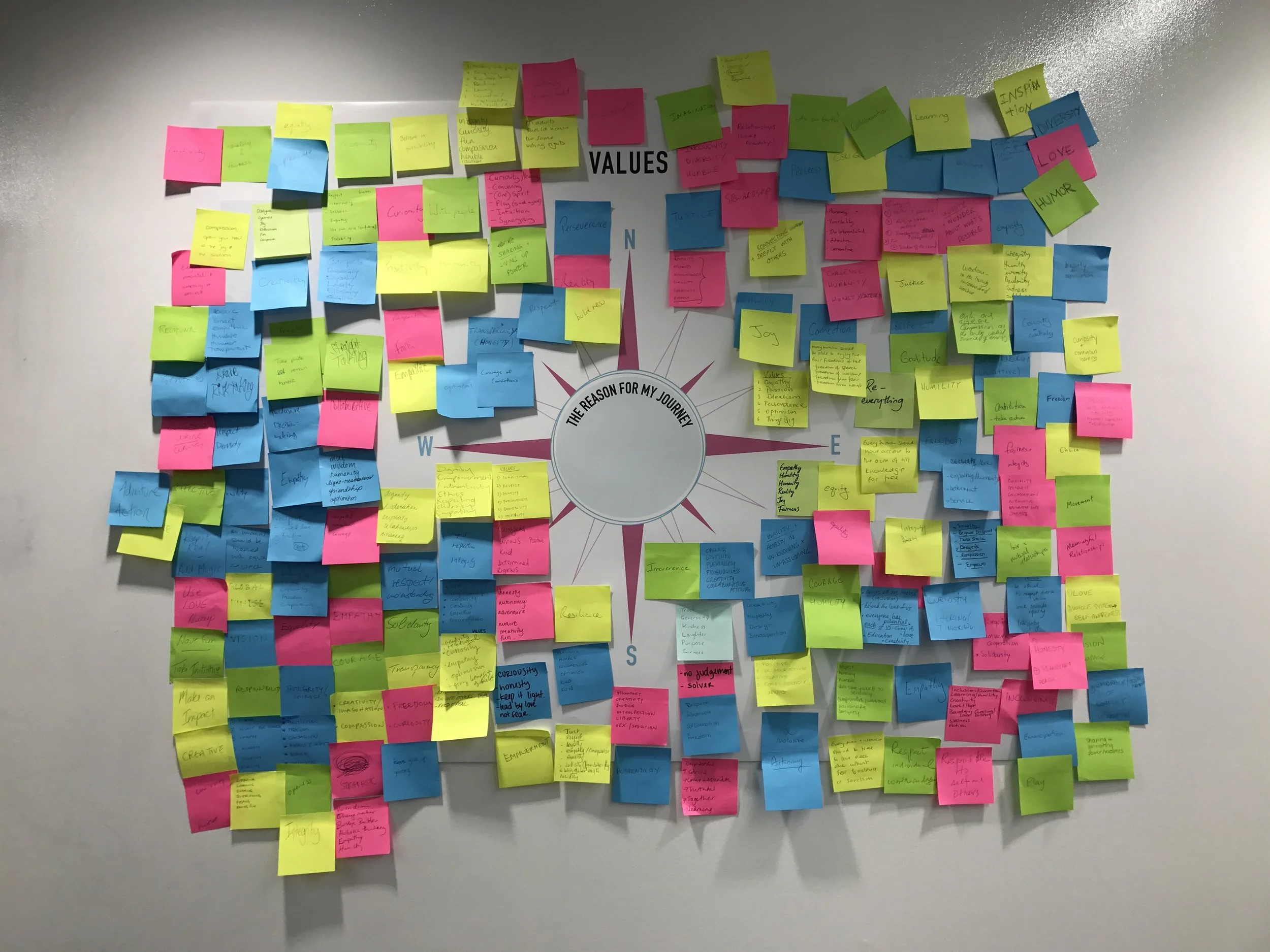
What values guide the field of social innovation?
What values guide the field of social innovation?
On Day 1 of the London Wayfinder, Danish MP, Uffe Elbæk asked us all to consider what values guide us in our work.
What is the reason for our journey? Why?
What values guide social innovation?

We each documented our values on post-it notes and mapped them against a shared compass to emphasize that these are the values keeping us individually and collectively on our path.
Below is a quick snapshot of the top ten values shared back during that session by frequency.
More to come on the values, insights and lessons from the Wayfinder soon!


A history and future of policy innovation
A rapid story from around the world and across the field: Alex Ryan of Alberta CoLab, on the history and future of policy innovation.
A rapid story from around the world and across the field: Alex Ryan of Alberta CoLab. This text was originally published on Alex's medium blog on Feb 22, 2017. Views are author's own.
Chapter 1. Of Pioneers, Rebels and Outlaws
These were the days of the Wild West of Social Innovation.
In the Netherlands, a small band of highwaymen formed a gang called Kennisland (Est. 1999) which set out to raid the Information Superhighway, using their plunder to build the Dutch knowledge economy. While their getaway vehicle was difficult to identify, these days we would recognize it as a Lab.
Meanwhile in Denmark, MindLab (Est. 2002) was busy throwing hand grenades at Danish bureaucracy and turning taxation into interpretive art installations.
Down under, TACSI (Est. 2009) set up shop as a radical start-up that would transform policy Family by Family. Their start-up formed outside the Australian government bureaucracy, launching their humble beginning in Brenton Caffin’s mum’s garage.
This motley collection of Lone Rangers might have gone down in folklore as isolated deviations from the dominant policy development paradigm of technical rationality, if not for the efforts of SIX (Est. 2008) plus Nesta (Est. 1998)to corral together the Magnificent Seven.
Chapter 2. A Hundred Labs Bloom
When historians look back, they will identify the date that lies somewhere between 2014 Rockefeller / Bridgespan lab survey and the 2015 Nesta global map of labs when the 100th #psilab was born.
By this mysterious date, governments across all scales had created: i-teams, nudge units, delivery units, design labs, change labs, living labs, agile policy labs, data labs, fab labs and innovation hubs! The landscape was reminiscent of China’s Zhangye Danxia Mountains. The terrain was colourful, variegated, and uneven, with spectacular peaks and treacherous valleys.

In 2014, the global public and social innovation lab landscape resembles the Zhangye Danxia Mountains.
This photo from CoLab’s most recent training course is one of those peaks. In it are the lead instructor, Brent Wellsch, and student, Nazar Poritskiy. Nazar is an energy policy analyst in the Government of Alberta. At the end of the 5 day course, Brent asked the students to summarize their experience in less than 3 words. Nazar was speechless, so instead he performed a handstand and walked across the room. I believe that sums up the best of the impact we can have when we empower our fellow public servants to unleash their social intrapraneur.

Nazar Poritskiy expresses the experience of CoLab’s systemic design training course.
Chapter 3: On Broadway
It’s 2017. You may have noticed some not-so-weak signals that our world is getting worse. Collectively, we are becoming more polarized, more inequitable, and more unsustainable. Once seemingly inexorable forces of progress — modern science, technological advancement, free press, free trade, free markets, religious tolerance, and cultural tolerance — are being called into question. Trust in the institutions that have advanced these agendas has eroded to an all-time low. People no longer trust government, the media, the banks, corporations, or their church. Experts are seen as elite and out of touch. Resistance movements have catalyzed revolutions, ranging from the Arab Spring to Brexit and from Pirate Parties to the Alt Right. Driving these events is an underlying dynamic of polarization, radicalization, and fragmentation of society into like-minded tribes with self-sealing belief systems. We are at risk of losing the ability to talk to each other and work together.
The social innovation movement offers an alternative path forward. We seek to activate the radical middle and convene unusual suspects. We attempt to break through silos and bubbles to focus people on working together differently to address our thorniest challenges. We challenge each other to redesign our institutions to be more human and more inclusive and more responsible and more responsive to our 21st century reality.
We need to keep doing this. But we need to think much bigger. We need more vision, more legitimacy, and more capacity if we are to turn the tide. In the words of Barry Mann, “I won’t quit till I’m a star On Broadway.”
Chapter 4: The Unusual Becomes Business as Usual
In 2027, there are no more policy innovation labs. This is not because the movement died, but because it succeeded. Governments don’t just talk of placing citizens at the centre, they do it habitually. Social innovation has migrated from water cooler talk to being in the water supply. Governments not only engage in policy innovation, but they also create comprehensive innovation policy. This extends beyond service redesign to include the full range of policy levers: government funding, procurement, assets, networking, convening, legislation, research, technology, citizen engagement, and measurement and evaluation. In this world, every public servant is a social innovator, and citizens are empowered and engaged to shape the policies that affect them and their families’ futures.